ENBD Rebrand
ENBD Rebrand
ENBD Rebrand
One bank. Six products. One Design System.
One bank. Six products. One Design System.
One bank. Six products. One Design System.
Leading the design-system rebrand
of Emirates NBD across six products, two sub-entities and 2.4 million users - and what it taught me about how design coherence actually scales.
Leading the design-system rebrand
of Emirates NBD across six products, two sub-entities and 2.4 million users - and what it taught me about how design coherence actually scales.
Leading the design-system rebrand
of Emirates NBD across six products, two sub-entities and 2.4 million users - and what it taught me about how design coherence actually scales.

Details
Details
Company: Emirates NBD
Project: 2025 - 2026
Role: Head of Visual Design and Interaction Design (Product Design)
Company: Emirates NBD
Project: 2025 - 2026
Role: Head of Visual Design and Interaction Design (Product Design)
Company: Emirates NBD
Project: 2025 - 2026
Role: Head of Visual Design and Interaction Design (Product Design)
CONTEXT
CONTEXT
One bank, six different experiences
The flagship app, online banking, the two business platforms, the ATMs, the branch kiosks - 2.4 million customers moving between products that shared a name and not much else. We built BrewBoard to measure how far their design had drifted apart, and the picture was clear: apart from the logo, almost everything had been shaped by the product it lived in - its needs, the team that built it, the moment it was built. Colours, components, the way a single action behaved - all of it varied from one product to the next.
None of this was anyone's doing in particular. Ownership was simply distributed: each product had an owner, each owner built for their own context, and the bank had never needed them to converge.
So it looked like a design problem. It wasn't, really. It was a question of where design decisions lived - and the rebrand was how we moved them somewhere shared.
One bank, six different experiences
The flagship app, online banking, the two business platforms, the ATMs, the branch kiosks - 2.4 million customers moving between products that shared a name and not much else. We built BrewBoard to measure how far their design had drifted apart, and the picture was clear: apart from the logo, almost everything had been shaped by the product it lived in - its needs, the team that built it, the moment it was built. Colours, components, the way a single action behaved - all of it varied from one product to the next.
None of this was anyone’s doing in particular. Ownership was simply distributed: each product had an owner, each owner built for their own context, and the bank had never needed them to converge.
So it looked like a design problem. It wasn’t, really. It was a question of where design decisions lived - and the rebrand was how we moved them somewhere shared.
One bank, six different experiences
The flagship app, online banking, the two business platforms, the ATMs, the branch kiosks - 2.4 million customers moving between products that shared a name and not much else. We built BrewBoard to measure how far their design had drifted apart, and the picture was clear: apart from the logo, almost everything had been shaped by the product it lived in - its needs, the team that built it, the moment it was built. Colours, components, the way a single action behaved - all of it varied from one product to the next.
None of this was anyone’s doing in particular. Ownership was simply distributed: each product had an owner, each owner built for their own context, and the bank had never needed them to converge.
So it looked like a design problem. It wasn’t, really. It was a question of where design decisions lived - and the rebrand was how we moved them somewhere shared.
BACKGROUND
BACKGROUND
The model underneath it
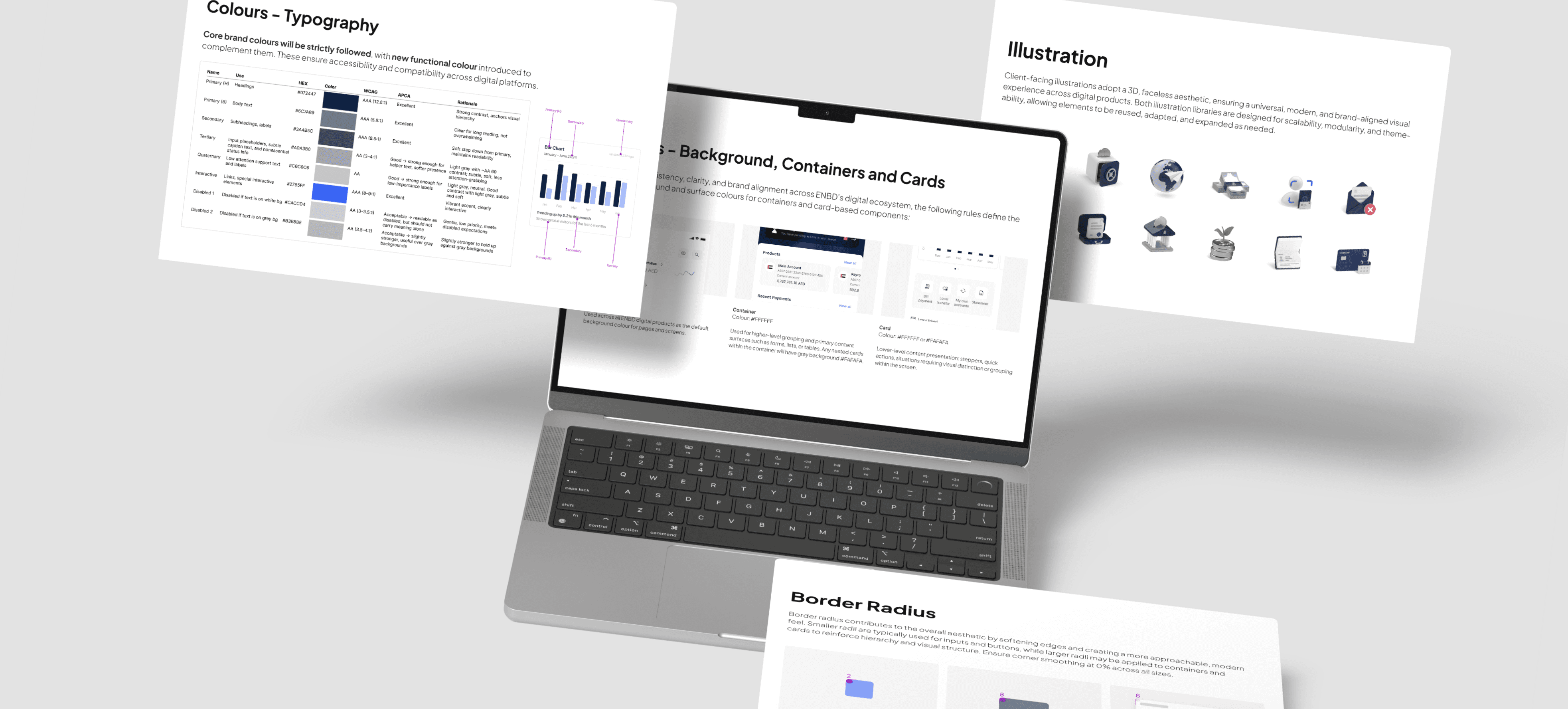
For years, the way Emirates NBD built digital products was simple and rational: the business that owned a product owned its experience. They sponsored it, funded it, and decided how it should look and behave. A design system existed, but in a world where each product answered to its own owner, following it was a choice rather than a default - and reasonable people, building for genuinely different audiences, often chose differently.
Two teams arrived at the same conclusion at almost the same time. Brand saw it from the outside: a masterbrand that no longer held together across touchpoints. Design saw it from the inside, in BrewBoard - products drifting steadily away from any shared foundation. Brand answered with a new identity: the positioning, the visual language, the Sails. My job was the other half - turning that identity into something seventy-plus designers and as many developers could actually build, consistently, across an app, a website, a corporate platform and an ATM.
What made that possible wasn't a design argument. It was an engineering one. A mandate from the CIO moved every digital product onto a single framework, Leap - shared, tested components that let teams build faster and more reliably. Coherence stopped being something to campaign for and became part of how products shipped. Our design system, Arabica, became the design layer of that framework: the bridge between what the brand wanted to feel like and what engineering needed to build.
The model underneath it
For years, the way Emirates NBD built digital products was simple and rational: the business that owned a product owned its experience. They sponsored it, funded it, and decided how it should look and behave. A design system existed, but in a world where each product answered to its own owner, following it was a choice rather than a default - and reasonable people, building for genuinely different audiences, often chose differently.
Two teams arrived at the same conclusion at almost the same time. Brand saw it from the outside: a masterbrand that no longer held together across touchpoints. Design saw it from the inside, in BrewBoard - products drifting steadily away from any shared foundation. Brand answered with a new identity: the positioning, the visual language, the Sails. My job was the other half - turning that identity into something seventy-plus designers and as many developers could actually build, consistently, across an app, a website, a corporate platform and an ATM.
What made that possible wasn’t a design argument. It was an engineering one. A mandate from the CIO moved every digital product onto a single framework, Leap - shared, tested components that let teams build faster and more reliably. Coherence stopped being something to campaign for and became part of how products shipped. Our design system, Arabica, became the design layer of that framework: the bridge between what the brand wanted to feel like and what engineering needed to build.
The model underneath it
For years, the way Emirates NBD built digital products was simple and rational: the business that owned a product owned its experience. They sponsored it, funded it, and decided how it should look and behave. A design system existed, but in a world where each product answered to its own owner, following it was a choice rather than a default - and reasonable people, building for genuinely different audiences, often chose differently.
Two teams arrived at the same conclusion at almost the same time. Brand saw it from the outside: a masterbrand that no longer held together across touchpoints. Design saw it from the inside, in BrewBoard - products drifting steadily away from any shared foundation. Brand answered with a new identity: the positioning, the visual language, the Sails. My job was the other half - turning that identity into something seventy-plus designers and as many developers could actually build, consistently, across an app, a website, a corporate platform and an ATM.
What made that possible wasn’t a design argument. It was an engineering one. A mandate from the CIO moved every digital product onto a single framework, Leap - shared, tested components that let teams build faster and more reliably. Coherence stopped being something to campaign for and became part of how products shipped. Our design system, Arabica, became the design layer of that framework: the bridge between what the brand wanted to feel like and what engineering needed to build.
APPROACH
APPROACH
Earning adoption
A system is only as real as its adoption, and adoption had to be earned across three groups - the stakeholders, the designers, and the developers - each coming to it for their own reason.
The first was the stakeholders: the businesses that owned each product. Moving to a shared system asked a great deal of them - new ways of working, real implementation cost, and often stretched teams already carrying full roadmaps. None of that hesitation was unreasonable; it was the rational response of people who had built something and were being asked to rebuild it. So the work here was less persuasion than partnership: making the case in their terms - faster delivery through Leap, a steadier experience for their customers - and carrying the change with them rather than handing it down. In the end, all six flagship products and both sub-entities, Liv and Emirates Islamic, came onto the system.
The second was the designers - more than seventy of them, across Dubai and India. Good designers interpret, and they should: an ATM cash withdrawal and a corporate maker-checker approval are not the same moment, and a system that ignores that difference deserves to be ignored. But interpretation at scale produces drift, and every gap in the guidelines was a place where two careful designers could reasonably disagree. So the system grew. We started with the foundations everyone shared - spacing, colour, and a typeface we tested specifically for legibility in dense financial tables, where the numbers are small and the stakes are not - then kept extending wherever BrewBoard showed teams diverging.
That is how three full guideline sets came to exist: UI, the Dirham symbol, and UX writing in English and Arabic. The system was never published once and left alone; it was extended, detail by detail, as the work showed us where it was thin. The proof it could hold was Business Online - multilayer permissions, maker-checker flows, complex payments - which moved from 5% to 80% on the shared system without losing what made it work.
The third was the developers, and the obstacle there was concrete: different platforms run on different stacks. One design system had to resolve to consistent, tested components whether it landed in the app, the browser, or fixed ATM hardware. This is where Arabica and Leap had to be one thing rather than two - and where it helped that the core team was built that way from the start: a design system lead, a senior design system engineer and a technical designer working alongside me. Coherence became the default not because anyone policed it, but because the component a developer reached for was already right.
Earning adoption
A system is only as real as its adoption, and adoption had to be earned across three groups - the stakeholders, the designers, and the developers - each coming to it for their own reason.
The first was the stakeholders: the businesses that owned each product. Moving to a shared system asked a great deal of them - new ways of working, real implementation cost, and often stretched teams already carrying full roadmaps. None of that hesitation was unreasonable; it was the rational response of people who had built something and were being asked to rebuild it. So the work here was less persuasion than partnership: making the case in their terms - faster delivery through Leap, a steadier experience for their customers - and carrying the change with them rather than handing it down. In the end, all six flagship products and both sub-entities, Liv and Emirates Islamic, came onto the system.
The second was the designers - more than seventy of them, across Dubai and India. Good designers interpret, and they should: an ATM cash withdrawal and a corporate maker-checker approval are not the same moment, and a system that ignores that difference deserves to be ignored. But interpretation at scale produces drift, and every gap in the guidelines was a place where two careful designers could reasonably disagree. So the system grew. We started with the foundations everyone shared - spacing, colour, and a typeface we tested specifically for legibility in dense financial tables, where the numbers are small and the stakes are not - then kept extending wherever BrewBoard showed teams diverging.
That is how three full guideline sets came to exist: UI, the Dirham symbol, and UX writing in English and Arabic. The system was never published once and left alone; it was extended, detail by detail, as the work showed us where it was thin. The proof it could hold was Business Online - multilayer permissions, maker-checker flows, complex payments - which moved from 5% to 80% on the shared system without losing what made it work.
The third was the developers, and the obstacle there was concrete: different platforms run on different stacks. One design system had to resolve to consistent, tested components whether it landed in the app, the browser, or fixed ATM hardware. This is where Arabica and Leap had to be one thing rather than two - and where it helped that the core team was built that way from the start: a design system lead, a senior design system engineer and a technical designer working alongside me. Coherence became the default not because anyone policed it, but because the component a developer reached for was already right.
Earning adoption
A system is only as real as its adoption, and adoption had to be earned across three groups - the stakeholders, the designers, and the developers - each coming to it for their own reason.
The first was the stakeholders: the businesses that owned each product. Moving to a shared system asked a great deal of them - new ways of working, real implementation cost, and often stretched teams already carrying full roadmaps. None of that hesitation was unreasonable; it was the rational response of people who had built something and were being asked to rebuild it. So the work here was less persuasion than partnership: making the case in their terms - faster delivery through Leap, a steadier experience for their customers - and carrying the change with them rather than handing it down. In the end, all six flagship products and both sub-entities, Liv and Emirates Islamic, came onto the system.
The second was the designers - more than seventy of them, across Dubai and India. Good designers interpret, and they should: an ATM cash withdrawal and a corporate maker-checker approval are not the same moment, and a system that ignores that difference deserves to be ignored. But interpretation at scale produces drift, and every gap in the guidelines was a place where two careful designers could reasonably disagree. So the system grew. We started with the foundations everyone shared - spacing, colour, and a typeface we tested specifically for legibility in dense financial tables, where the numbers are small and the stakes are not - then kept extending wherever BrewBoard showed teams diverging.
That is how three full guideline sets came to exist: UI, the Dirham symbol, and UX writing in English and Arabic. The system was never published once and left alone; it was extended, detail by detail, as the work showed us where it was thin. The proof it could hold was Business Online - multilayer permissions, maker-checker flows, complex payments - which moved from 5% to 80% on the shared system without losing what made it work.
The third was the developers, and the obstacle there was concrete: different platforms run on different stacks. One design system had to resolve to consistent, tested components whether it landed in the app, the browser, or fixed ATM hardware. This is where Arabica and Leap had to be one thing rather than two - and where it helped that the core team was built that way from the start: a design system lead, a senior design system engineer and a technical designer working alongside me. Coherence became the default not because anyone policed it, but because the component a developer reached for was already right.

RESULTS
RESULTS
What moved
BrewBoard measured adherence as the share of each product built from the shared system rather than custom or one-off code. Over roughly a year, the picture changed across the estate:
What moved
BrewBoard measured adherence as the share of each product built from the shared system rather than custom or one-off code. Over roughly a year, the picture changed across the estate:
What moved
BrewBoard measured adherence as the share of each product built from the shared system rather than custom or one-off code. Over roughly a year, the picture changed across the estate:

Three things are worth reading in those numbers. The products that began near zero - Business Online, Kiosk, ATM, the international rollout - weren't so much improved as stood up on a shared foundation for the first time. ENBD X, where most of those 2.4 million customers actually live, went from a quarter-aligned to 85%. And Business Banking, already the most disciplined, closed the hardest distance of all: the last stretch from very good to nearly complete.
The lower numbers matter too, and I would rather show them than round them away. ATM at 73% and the KSA and Egypt rollout at 68% are the hardest contexts in the estate - fixed hardware, new markets - and they sit lower precisely because they were hardest. A wall of identical high numbers would be less true, and less useful.
Three things are worth reading in those numbers. The products that began near zero - Business Online, Kiosk, ATM, the international rollout - weren’t so much improved as stood up on a shared foundation for the first time. ENBD X, where most of those 2.4 million customers actually live, went from a quarter-aligned to 85%. And Business Banking, already the most disciplined, closed the hardest distance of all: the last stretch from very good to nearly complete.
The lower numbers matter too, and I would rather show them than round them away. ATM at 73% and the KSA and Egypt rollout at 68% are the hardest contexts in the estate - fixed hardware, new markets - and they sit lower precisely because they were hardest. A wall of identical high numbers would be less true, and less useful.
Three things are worth reading in those numbers. The products that began near zero - Business Online, Kiosk, ATM, the international rollout - weren’t so much improved as stood up on a shared foundation for the first time. ENBD X, where most of those 2.4 million customers actually live, went from a quarter-aligned to 85%. And Business Banking, already the most disciplined, closed the hardest distance of all: the last stretch from very good to nearly complete.
The lower numbers matter too, and I would rather show them than round them away. ATM at 73% and the KSA and Egypt rollout at 68% are the hardest contexts in the estate - fixed hardware, new markets - and they sit lower precisely because they were hardest. A wall of identical high numbers would be less true, and less useful.
REFLECTION
REFLECTION
Why this matters more now
Something else happened across the same months: the bank changed how it builds. Developers gained AI assistance and an internal IDE, and work that once took days began taking hours. I won't claim the design system caused that - cloud, tooling and AI did, together, and separating their contributions honestly isn't possible.
But the system is what made that speed safe. Acceleration without a shared foundation doesn't produce coherence faster - it produces fragmentation faster, every team generating its own version of everything at machine speed. Tested, shared components are precisely the guardrail that lets a bank build at AI pace without coming apart. The faster the bank moves, the more the system earns its place.
Which is the part I keep coming back to. We set out to make one bank feel like one bank, and we got there by moving design decisions somewhere shared. It turned out that shared place was also what let the bank move quickly without losing itself. A design system reads like a craft project. At this scale, it's the quiet infrastructure that lets everything else move at once.
Why this matters more now
Something else happened across the same months: the bank changed how it builds. Developers gained AI assistance and an internal IDE, and work that once took days began taking hours. I won’t claim the design system caused that - cloud, tooling and AI did, together, and separating their contributions honestly isn’t possible.
But the system is what made that speed safe. Acceleration without a shared foundation doesn’t produce coherence faster - it produces fragmentation faster, every team generating its own version of everything at machine speed. Tested, shared components are precisely the guardrail that lets a bank build at AI pace without coming apart. The faster the bank moves, the more the system earns its place.
Which is the part I keep coming back to. We set out to make one bank feel like one bank, and we got there by moving design decisions somewhere shared. It turned out that shared place was also what let the bank move quickly without losing itself. A design system reads like a craft project. At this scale, it’s the quiet infrastructure that lets everything else move at once.
Why this matters more now
Something else happened across the same months: the bank changed how it builds. Developers gained AI assistance and an internal IDE, and work that once took days began taking hours. I won’t claim the design system caused that - cloud, tooling and AI did, together, and separating their contributions honestly isn’t possible.
But the system is what made that speed safe. Acceleration without a shared foundation doesn’t produce coherence faster - it produces fragmentation faster, every team generating its own version of everything at machine speed. Tested, shared components are precisely the guardrail that lets a bank build at AI pace without coming apart. The faster the bank moves, the more the system earns its place.
Which is the part I keep coming back to. We set out to make one bank feel like one bank, and we got there by moving design decisions somewhere shared. It turned out that shared place was also what let the bank move quickly without losing itself. A design system reads like a craft project. At this scale, it’s the quiet infrastructure that lets everything else move at once.

CREDITS
CREDITS
*Emirates NBD digital rebrand, 2025–2026. Six flagship products and two sub-entities (Liv and Emirates Islamic) on a shared codebase; 2.4 million active users; 70+ designers across Dubai and India; delivered over twelve months. Arabica design system and BrewBoard built with the design-system core team: Marco (Design System Lead), Irfan (Senior Design System Engineer) and Gabby (Technical Designer). Brand identity led by the Emirates NBD brand team.*
*Emirates NBD digital rebrand, 2025–2026. Six flagship products and two sub-entities (Liv and Emirates Islamic) on a shared codebase; 2.4 million active users; 70+ designers across Dubai and India; delivered over twelve months. Arabica design system and BrewBoard built with the design-system core team: Marco (Design System Lead), Irfan (Senior Design System Engineer) and Gabby (Technical Designer). Brand identity led by the Emirates NBD brand team.*
*Emirates NBD digital rebrand, 2025–2026. Six flagship products and two sub-entities (Liv and Emirates Islamic) on a shared codebase; 2.4 million active users; 70+ designers across Dubai and India; delivered over twelve months. Arabica design system and BrewBoard built with the design-system core team: Marco (Design System Lead), Irfan (Senior Design System Engineer) and Gabby (Technical Designer). Brand identity led by the Emirates NBD brand team.*
Any comments or questions?
I’d love to hear from you.
Any comments or questions?
I’d love to hear from you.
Any comments or questions?
I’d love to hear from you.
Contact
Contact
Contact